Monday, July 15, 2019

The Vast Midwest


A relaxing and hot bike ride along the Cedar River
before starting another long day on the road
Political commentators sometimes refer to the Midwest as ‘flyover country,’ a vast prairie between major US cities on each coast.  We felt that way on our 2016 road trip with our Airstream going from Oregon to MA and back, viewing it as ‘something to get through.’ 

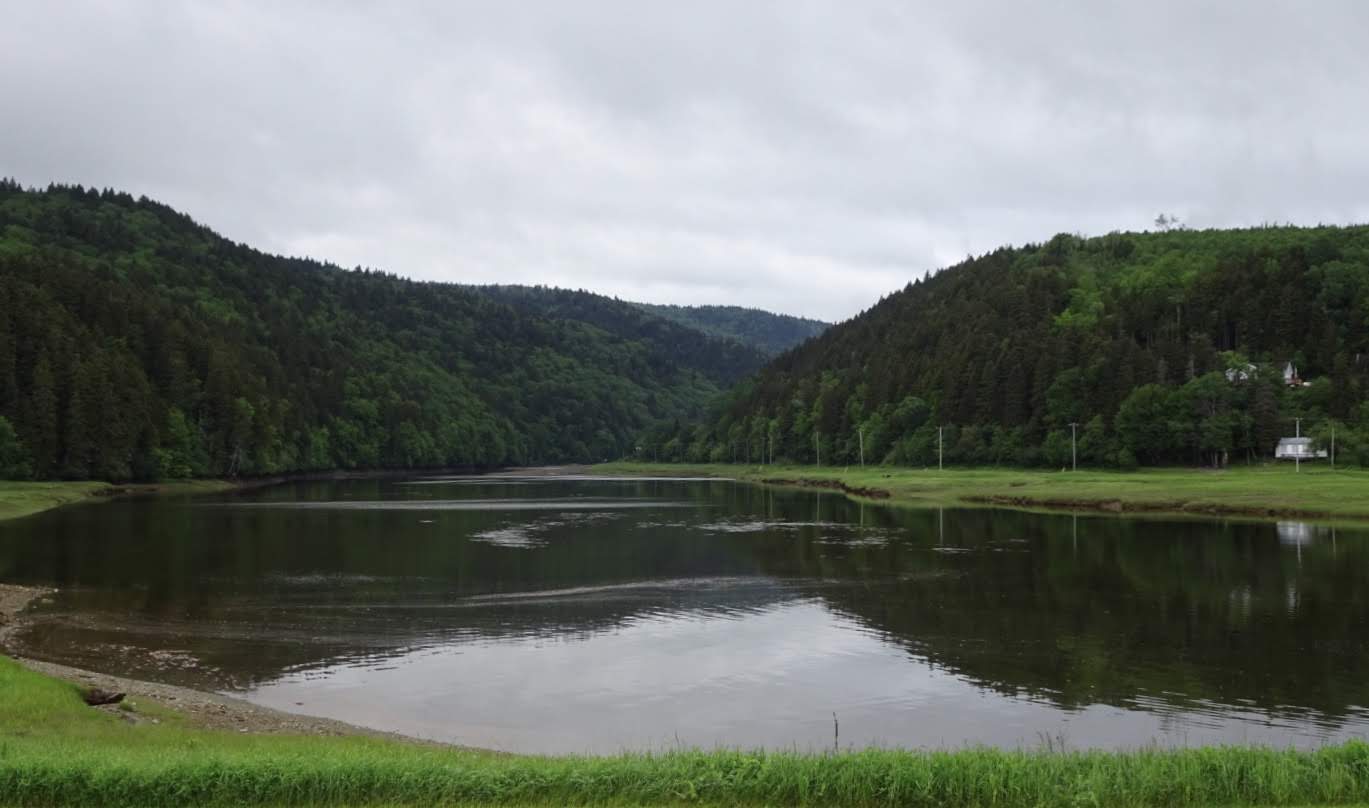
Somewhere in western NB
This time we feel differently.  Yes, we still have to get through it, but we are approaching it with a different attitude and a different route.  The Interstate highways of New York, Pennsylvania, Ohio, and some of Indiana drove us crazy and dinged us with tolls every few miles.  So we opted for the two-lane back roads, which were often predecessors of the Interstates. 


Indiana, near IL border


The Westcott Home in Springfield OH, part
of our inadvertent  Frank Lloyd Wright Tour


This opened up opportunities for detours and stops that were never part of our itinerary.  One was a walk through 'Millionaires Row' and another Frank Lloyd Wright home (the Westcott home) in Springfield, OH, followed by a lunch stop at a western revolutionary war battlefield and a historical site for Tecumseh, the great Indian leader.


And following a night at a delightful Indiana campground far from the freeway, we landed in another Springfield, the Illinois state capitol and the home of Lincoln.  
Lincoln's Home, complete with many original
furnishings.  It was an eerie to touch the same
handrail he did as we ascended the stairs. 
It was never on our itinerary, but we are so grateful we saw Lincoln’s home, museum/library, offices, and more.  Up until now, we knew about slavery in an abstract sense, the kind taught to us in elementary school.  The museum made it real for us.  


Outside the Lincoln Museum
and library


As a bonus the next morning, we visited yet another Frank Lloyd Wright home, (the Dana Home) circa 1904.  It was one of Wright’s first major commissions. His benefactor had no budget constraints, and the home was huge, complete with a bowling alley and barrel ceilings in two rooms.


The Dana Home


From there, we proceeded on leisurely back roads to La Porte City, IA to visit Kathy’s college friend and one who was indirectly responsible for Kathy and me meeting 44 years ago.


The last two days have been the most relaxing drives of our five+ weeks so far, following Highway 20 through the Midwest.  (Highway 20 goes from Boston MA to Newport, OR.) Although the extreme heat, humidity, and mosquitoes are oppressive, we are fascinated by how the countryside changes (and grateful for an air conditioned vehicle).  It’s a very subtle transition from the hills and forests of the Allegheny Mountains; to the cornfields of Indiana, Illinois, and Iowa; to the rolling prairie wheat fields of western Nebraska; to the rocky buttes and grasslands of Wyoming.  But it happens.  And now that we’re in Wyoming, we feel almost back home--in the West--our comfort zone.
Wetlands in northern IA


It’s also fascinating to us how we can drive for miles and miles through vast nothingness, then come upon small towns with museums, public swimming pools, skate parks, and free camping (often with hookups) in their city parks or fairgrounds.  This free camping seems to be part of the Midwest hospitality ethos, and compared to the East, everyone is so nice.

No more cornfields as we approach WY

Every tiny town seems to have an historical museum and library.  Indeed, we’ve passed more museums in the past three days than McDonald’s, and certainly no Starbucks.

We often wonder, ‘Why do people live here?’  It’s certainly not where we would live, with its heat, humidity, brutal winters, flatness, and mosquitoes, lack of mountains and oceans, and big city amenities. But then, we didn’t grow up here and haven’t the connections to the land or its people.

Our free campground in the Douglas, WY city park on
the banks of the North Platte River
"WHAT WE CAN, WHILE WE CAN!"


Wednesday, July 10, 2019

To Fallingwater and Beyond!


Looking upstream to Fallingwater
We enjoyed a fun week in the Berkshires at a mountain cottage we co-own with our daughter, Skyler.  What made it so nice was all of her guests coming and going.  We realized just how much we miss being in the company of young people.  We swam and paddle boarded on the lake, rode bikes, played with our ‘granddogs,’ sat around the campfire, and listened to John Williams and the Boston Pops at the Tanglewood Festival.  Above all, we ate, and ate, and ate.  Skyler, Spencer, and Feruza are such good cooks.


Cruising the lake at Sunset, July 4 with
Skyler's friends and coworkers


Sunset on Big Robin Lake

Waiting for John Williams to conduct his
greatest hits at the Tanglewood Festival


We left Monday toward Pittsburgh, to see the famous Fallingwater home designed by Frank Lloyd Wright.  It is listed in the Smithsonian’s “Life List of 28 places to visit before you die.”  And just this month, UNESCO listed Fallingwater as a world heritage site.  Together, we’ve seen about 12 of his homes, and several non-residential buildings. They were all interesting and nice to look at, but we wouldn’t want to live in one.   But we could happily live in Fallingwater.  It’s stunningly beautiful and practical at the same time. 

Falling Water, looking downstream
The home was commissioned in 1932 by Edgar and Liliane Kauffman who owned a huge department store in Pittsburgh.  The budget was $35,000, but in true Frank Lloyd Wright style, it the total cost was $155,000—about $2.8 million in today’s dollars, not counting the land.  (The Conservancy’s budget for needed restorations is over $11 million.)  That included furnishings, servants’ quarters, and carport.


The Kauffman’s wanted the home to look across the river to the waterfalls.  Frank instead designed the waterfall to be a part of the home.  You can see more photos of it HERE, as well as a second FLW home we toured nearby called Kentuck Knob. (Unfortunately photos inside were prohibited). While on the Kntuck Knob tour, we were privileged to meet its owner, Lord Peter Palumbo, a British philanthropist who buys and preserves historic properties.  He showed up in his vintage 1982 Buick Roadmaster station wagon to get some wine out of the cellar.
View from the Kentuck Knob property


As luck would have it both nights out of Becket, we stayed at wineries as members of Harvest Host.  The wines weren’t so good, but the ambiance and quiet were.  Although they are free to members, we purchased a bottle of wine at each place.


Our Harvest Host campsite Tuesday night


It seems like we’ve spent more money on tolls than on gas since we left Becket,  barely getting out of 4th  gear before another booth.  One toll was over $34!  It would have been even more if our trailer had two axles.  But the roads were good, fast, stressful, loaded with trucks, and yet boring! 

A refurbished historic mile make
At a rest stop we noticed some historical markers.  The toll roads were I-70, the Dwight D. Eisenhower Highway. He got the idea for our interstate highway system in 1919, as he led a 62-day convoy from Washington DC to San Francisco.  He signed the enabling legislation in 1956.  With the Cold War anxieties in mind, it was sold as the National Defense Highway System.  (In a similar vein in 1957 when the Soviet Sputnik satellite was launched, Congress passed the National Defense Student Loan Program, of which Kathy and I, and many baby boomers used for low-cost student loans.)

But what really caught our eye was the Historic Highway 40 interpretive sign.  Commissioned by Thomas Jefferson in 1806, it originally connected the Atlantic Ocean with the Ohio River.  In 1926 it became the original coast-to-coast US highway.  It parallels I-70 and in some places I-70 is US 40. We decided to get off the three-lane I-70 and take US 40 through several quaint eastern and Midwest towns.  Some of these towns looked prosperous, others were rundown with many shuttered stores and factories.  Later on, as we approached Columbus, it was lined with strip malls. 

Tomorrow (Thursday), we’re going to spend the morning in nearby Springfield, OH.  Any guesses what we’ll be doing?  Kathy wants to tour yet another FLW home and walk the historical neighborhoods in the 90 degree heat and 85% humidity.  Over our 42 years of marriage, I have grown to enjoy her passion for architecture, as she has for my passions of symphonic music and cooking.

Then off towards another Springfield—Lincoln’s home town.
Fallingwater in background

 "WHAT WE CAN, WHILE WE CAN!"


Tuesday, July 2, 2019

The Amazing Bay of Fundy

We'd be 30 feet under water
seven hours later
Crossing Canada, one of our main objectives was to see the Bay of Fundy between New Brunswick and Nova Scotia.  One of the Seven Wonders of North America, this UNESCO site was was well worth the effort. The bay has tides five-ten times higher than the rest of the world.  They can reach up to 56 feet in the upper reaches of the bay.

Over 100 billion tons of water flow in and out of the Bay of Fundy every day.  The flow of water equals 24 hours of that of all the fresh water streams and rivers on earth combined! Think of it--more than the Mississippi, Amazon, Nile, Columbia and many more rivers every day.


Hopewell Rocks at low tide
Why is this?  The bay is funnel shaped, becoming narrower and shallower as it progresses inland.  The Bay is 62 miles across and 400-700 feet deep at its mouth.  But it tapers off over 181 miles, to 1.5 miles wide and 35 feet deep at low tide.  This length makes it synchronous with the Atlantic Ocean's tide cycle, creating what we know as the 'bathtub effect' when waves are amplified by the ocean.  I think it also has something to do with being distant from the equator, because when we lived in Malaysia, we seldom saw tides above 18 inches.
The Gulf of Maine and the Bay of Fundy

Almost low tide at the Alma harbor


The next morning about an hour from high tide


Near low tide at Fundy National Park

The next morning, an hour before high tide


You can see a few more photos HERE

We were going to spend an extra day hiking in the national park, but we decided it is better to spend the day driving in heavy rains than hiking in them.  This got us into Becket, MA in the Berkshires our East Coast goal, two days ahead of time.  Skyler has a cottage there.

But the drive from the outskirts of Augusta to Becket wasn't pleasant.  In fact, it was rather stressful pulling a trailer.  We'd become too accustomed to courteous and slower-driving Canadians on two lane roads.  The Mass Turnpike, with its 70 mph limits, three lanes of heavy traffic, and legendary 'Mass-hole' drivers was quite a culture shock.

We'll be here for a few days, experiencing some the Tanglewood Festival and catching up with some of our family. Skyler, Spencer, their dogs and a friend are coming here for the long weekend, as is Feruza from New York with two friends.  Looks like the Airstream will be a backup bedroom, but not for us.  It felt so good to sleep on a queen bed last night!

Kathy drove the last hour and did a
yeoman's job of backing the trailer 75 feet
into it's tight resting spot.
Challenging back up job


Friday, June 28, 2019

Quebec--North America's France

One of several historic city gates to Quebec
We loved Quebec, especially Quebec City.  It's like Paris without the Eiffel Tower and all the dog shit on the sidewalks.

Founded in 1608, it is the last narrow point on the St. Lawrence River and was a major port, political capital, and focal point of British, French, and US military designs.  Its citadel is huge, the largest fortified city north of Mexico.

The St. Lawrence & Quebec port


Beyond the citadel, old Quebec if full of narrow quaint streets and alleys, reminiscent of Europe, and France in particular.

One of many street scenes.  We ate on the left.


The massive Fairmont Hotel was the meeting place for Roosevelt, Churchill, and Canadian PM Smith to plan D-Day. 


The Fairmont hotel


Nice, but a few too many mosquitoes


We camped upriver in a beautiful forested national park, next to Isle de Orleans.  After lunch at a winery with just so-so wines, we bicycled partly around in 80 degree heat and 80% humidity.  We were also right next to Chutes Montomorecy a huge waterfall taller than Niagara Falls.


Chutes Montomorecy
You can see more photos HERE.

We drove over 400 miles today along the St. Lawrence River then through beautiful, hilly farmland and forests.  (Sorry, no photos, but parts were definitely photo worthy).  Now that we're in New Brunswick, it's nice to see road signs in English, and have people speak English with us.  We're within two hours of the Bay of Fundy, the place with the massive tides.  Then back to the USA via Maine.
Leisurely Charcuterie lunch in Quebec City


WHAT WE CAN, WHILE WE CAN


Thursday, June 27, 2019

Ottawa and Montreal

On the locks of  the Rideau Canal
After five straight days of driving from Calgary, it felt so good to not be behind a windshield.  Having been in many capital cities in the world, we weren't expecting much.  But Ottawa  (population almost one million) was much like Washington DC.  Lots to see and do, and we hit perfect weather for it.


The Rideau Canal next to Parliment


We drove part way into town, then rode our bikes into downtown.  We've come to realize that riding bikes in any downtown is much less stressful than driving and finding a parking place.  And on our second day, we found a nice route along the Rideau Canal.

Our morning commute to downtown Ottawa
Over 120 miles long, and carved out of granite for much of its route, it was built between 1826 and 1832 for military purposes.  It connects the Ottawa River with Lake Ontario. (By comparison, the Erie Canal, 363 miles long, was completed in 1825.)  Over 1,000 Irish workers died of disease during the construction, mostly from malaria.  We'd believe it, based on the mosquito bites we got in our campground.


We witnessed the pomp and circumstance of the changing of the guard in front of the Parliament building, undergoing a 10-year renovation.  Many of the buildings there made us feel that we were at Hogwarts.

Hogwarts?  Or the House of Commons?
We also got to watch another one at the home of the Governor General, Canada's first astronaut.  She was out of town, so we got to see more of the residence (photos are in the link below).  The grounds were beautiful.  The Governor General is the Queen's representative, and has duties similar  to that of an American Vice President.

Inside the House of Commons


We also toured the home of two prime ministers of the WWI and WWII era, saw the obligatory Gothic cathedral,  toured the House of Commons (built in a former courtyard), and enjoyed an excellent Indian and French lunch.


I'm writing this in Quebec, and like every other Canadian city we've visited, we've enjoyed the ethnic diversity.  People of all creeds, attire, and ethnicity seem to mingle with each other and get along.  Canada's liberal immigration policy is its strength, especially when countries in Europe, Asia, and even in the US are approaching flat or negative population growths and strains on their pension systems.  This diversity creates some wonderful dining opportunities, as well.

You can see more photos of our Ottawa photos HERE.

MONTREAL

Bike path on our island campground
We didn't get to see as much of Montreal as we had wanted.  It was twice the size of Ottawa and the weather didn't cooperate on our sightseeing day.  We arrived on Discovery Day, Quebec's version of our 4th of July.  By law, everything from Walmart, to Ikea to Mom and Pop establishments were closed.  

But we took advantage of the beautiful weather on our island campground (a national park) on the St. Lawrence River and bicycled around it and watched the locals enjoy the holiday.  As always, our campground neighbors were so helpful and friendly.

It rained a lot the next day.  We drove to a park and ride, then took the subway into downtown Montreal. The heavy rain made the cathedral and an indoor market a refuge, but in the end the museum Pointe-a''-Calliere made the day most satisfying.

The Museo Pointe-a''-Calliere
Built on the archaeological ruins of Montreal from 600 ago to today, we got a good sense of the history about this place and North America.  Best of all, it had a fabulous traveling exhibit about the history of French cuisine.  Think what you may, but these two food geeks spent a good two hours there. 

We don't  have a lot of Montreal photos, but what we do have are HERE.

Stay tuned for our next post on Quebec--We love it and took a lot of photos.

WHAT WE CAN, WHILE WE CAN!

Thursday, June 20, 2019

The (Long!) Trans Canadian Highway


At a lunch stop at Indian Head,
somewhere along Hwy 1
We’ve driven 1900 miles since our Sunday departure from Calgary along Highway 1, the Trans Canadian Highway.  It’s the longest national road in the world.   Today was a light day, ‘only’ 273 miles.  Yesterday was 425—a bit too much pulling a trailer and having it push us down curvy steep hills. 


Canadian prairie, Manitoba 
The first 2.5 days out of Calgary were flat, straight, and green prairie.  Gradually the scenery transitioned to more trees to the point that yesterday and today we were in coniferous and deciduous forests all day, with occasional glimpses of Lake Superior, with lots of hills and curves.  At least half of the time the highway is a two lane road with frequent passing lanes.  Fortunately, traffic seemed light, but with frequent construction delays and often rough roads.  The first two days, the speed limit was 60-65 mph.  But the past three days it's been 55.  The towns and cities seem so far away from each other!


Lake Superior near Sault St. Marie

We’re not doing all 4800 miles of Hwy 1, which starts in Victoria BC and ends St. Johns’s Newfoundland.  Our goal was to simply get across the prairie and the vast southern interior.  We’re 300 miles from Ottawa, where we plan to spend a couple of days, then more quality time in Montreal and Quebec. 


We started near Banff, hope to make it to Nova Scotia

Near Thunder Bay, overlooking Lake Superior
Close (sort of) to Grand Rapids, MI
So what’s it like driving about 400 miles a day?  For the driver, it’s tedious and fully engaged, especially with 5500 pounds and an extra 21 feet behind us. However, we’re scenery geeks, (especially me) even flat prairie.  We’re working our way through an excellent audio book about Alexander Hamilton. (What a giant!) And we often default to about a half dozen of our favorite Sirius Radio stations from symphonic to hard rock.  Or sometimes silence, happy and content with the person next to us and ‘Jackson’ our Airstream behind us.  It wouldn’t be fun alone.  When Kathy isn’t driving, she’s finding our campsite for the night and beyond, or dealing with Assistance League emails.

And speaking of campgrounds, they are all starting to blur together.  Tonight we’re in a nice, but mosquito infested, provincial park with lots of privacy and hiking trails.  We’ve stayed in a delightful city park, and two commercial places. Our fellow campers are friendly—to the point where we were playing a scrabble-like game over wine and chocolate with our neighbors next door two nights ago.
Davis Lake CG, Ignace Ontario.  Great
 studio for my drum practice pad


Rapids on our hike in our campground tonight at
Chues Provincial Park, Massy Ontario 


If you missed our Facebook or Instagram posts about the Tyrell Royal Museum, we spent a couple of hours there Sunday before starting our eastward journey.  It was the best natural history museum we’ve ever experienced.  It, and the surrounding dig sites are huge.


Well worth the detour!


Tomorrow Ottawa—and two nights in the same place!

"What We Can, While We Can!"


Saturday, June 15, 2019

The Spectacular Canadian Rockies and Calgary


There are many kinds of visual beauty in the natural world.  The pastoral beauty of verdant farmlands, the serene beauty of flowered meadows and lakes, the relaxing beauty of the Oregon coast, or the mellow beauty of wine country.  And then there is the category of spectacular beauty.  Banff and Jasper national parks knock that category out of the park.
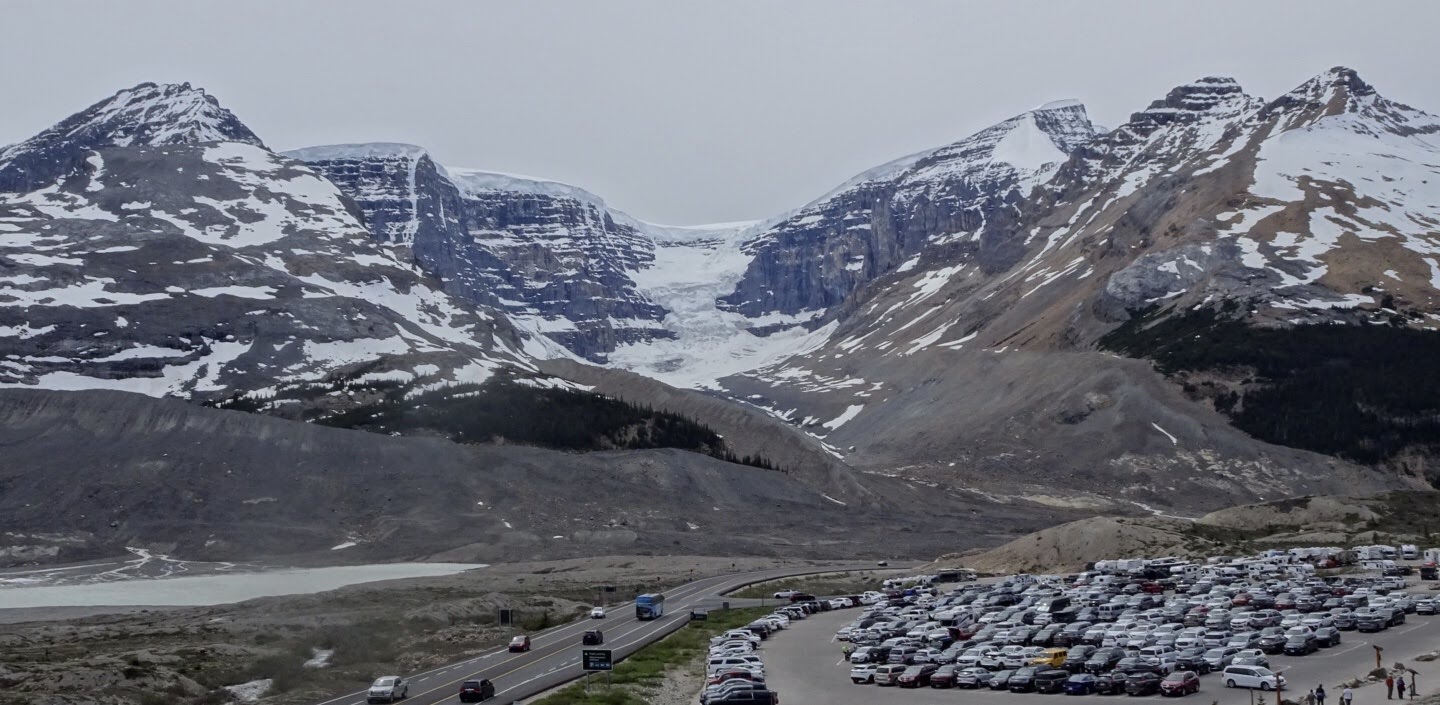
At the Crow's Foot Glacier, Jasper NP Canada


We spent three nights in rustic campgrounds in Banff and two at Sunwapta Pass in Jasper National Park.  The beauty was simply jaw dropping, making it hard to drive, especially pulling our trailer.  But riding bikes for a day gave us expansive vistas, and a great workout, especially at this higher altitude.

Kathy heading into an 8% downhill
grade outside Banff

This year, they didn’t get much snow, so our views were more like you would see in late July or in August.  Global warming is evident everywhere with receding glaciers and massive pine beetle infestations.  That said, our drive through the Columbia ice fields was probably the most beautiful drive of our lives.  Our only complaint is the shortage of pullover places to stop for a photo or to just gawk at the majesty.
The Ice Dome Glacier from the
Columbia Ice field Center

The Snow Dome, just three miles from our campground is a massive glacier, and the birthplace of three rivers, including the mighty Columbia.  The other two flow to the Arctic and Atlantic Oceans.  The glacier is receding about 15 feet per year.  Go while you can, and many tourists from all over the world are doing just that.   

Near Medicine Lake, NE from Jasper
An interesting fact:  The towns of Banff and Jasper are owned by the Parks Canada.  Thus, there are no lavish mansions, B&B’s and second homes like you would see in Aspen, Telluride, or Jackson Hole.   You have to document a purpose for living there, such as teaching in the local school, working in the park, or in the hospitality industry.  Thus, rents are reasonable, and retirees generally don’t live there.


For more photos that don’t do this spectacular beauty justice, check out THIS LINK.

Calgary

Calgary was quite a pleasant surprise.  We spent two nights in Calgary, a huge city of 1.5 million and massive skyscrapers and famous for its annual Calgary Stampede rodeo.  It’s a young city, first settled in 1884 and incorporated in 1894.  It is clean, vibrant, hip, and diverse. We drove three miles from our campground to a park and ride, then rode the train into town. 

We toured Studio Bell, Canada’s answer to Cleveland’s Rock and Roll museum.  Much of the focus was on Canadian musicians, many of whom have had a huge presence on the American music scene.  It also focused on the science of music and how instruments work.  But it can’t hold a candle to Cleveland’s R&R museum.  The best thing about it was the building itself, truly an architectural work of art.
Studio Bell


Today we enjoyed a long walking tour of downtown Calgary.  This place just oozes art, architecture, and energy.  And speaking of energy, that’s what this town is built upon—oil, gas, and more.   We loved the library, an architecture creation of beauty and function.

Entrance level to the library

Inside the Wonderland
Head Sculpture
The Wonderland
Head Sculpture


You can see a few more photos of Calgary at THIS LINK.

Tomorrow, after a brief visit to a dinosaur dig north of here, we start our 2400 mile drive across the prairies to Quebec.  If time permits, we might make it to Nova Scotia.  But our goal is to be in NW Massachusetts by July 3 to spend the long 4th of July weekend with Skyler, Spencer, and Feruza in the Berkshires, and to attend the Tanglewood Music Festival.  You can follow us in more real time on Facebook and Instagram (@KelemenRon). 

"WHAT WE CAN, WHILE WE CAN!"