Wednesday, March 12, 2014

Quito and Beyond


Wednesday, March 12, 2014

Today we got out of the hectic business center of town and traveled through clogged traffic to explore  historic old town of Quito, with settlements and buildings dating back 500 years. While the 13 US colonies were basic back waters and farmers struggling to survive, this part of the world was doing quite well, thank you, due the immense wealth of resources,  and the distance from Spain and the Vatican.  The narrow streets, the architecture, the Presidential Palace, the Archbishop’s residence, and the stunning Cathedral Saint Francis Xavier all had distinct design, unique to the rest of the world. 


Inside the Archbishop's palace

At Freedom Square


We’ve been to a lot of cathedrals over the years and were expecting more of the same.  But this just blew us away.  Never have we seen a cathedral so opulent, beautiful,  or breathtaking. It was financed by the wealthy Jesuits and was completed over 300 years ago.  The main construction was stone painted with gold leaf. The paintings and statues were also exquisite.


We spent some time at the equator and learned some amazing facts about it.  Water going down a sink drain actually does go in a different direction, depending upon which side of the equator you are on.  Even moving the sink 10 feet from the line changed the funnel cloud from clockwise to counter clockwise.  We also learned about the French scientific expedition to determine the location of the equator in 1726 or so—long before the US Declaration of Independence and the Lewis and Clark expedition.  It took over three years and triggered a lot of interest in science and later some political events.  Ecuador, by the way, is Spanish for equator.


You won’t hear for us for at least another six days.  We get up at 3:00 am on Thursday and fly the 500 miles to the Galapagos islands, where we will be on a small boat cruise, hiking some islands, and snorkeling.  No Wi-Fi, internet, email or phone.  What a novel idea for a vacation!

Tuesday, March 11, 2014

Ecuador--Quito & Otavalo

Tuesday, March 11

We love arriving in a new country.  It always takes a little adjustment from the one from which we just came, and the temptation is to compare one against the other, or against your own country. 

That said, Ecuador is nice, beautiful, and it really seems to have its act together environmentally and economically.  Inflation was well over 100% in 1999, so in 2000 they converted to a currency that the government couldn’t print—the US dollar.  And since so much of its exports (oil, roses, agricultural products, etc.) are to the USA, it was relatively easy.  Gas prices are really cheap.
 Quito, where we are staying is hilly and beautiful, about 5 million people, and about 35 miles long and 30 miles wide, with lots of traffic.  But nothing compared to Hanoi, Saigon, or even Portland.
The Otavalo rose growing region


Today we crossed into the northern hemisphere as we rode many miles over deep canyons and interesting geologic formations and ecosystems to the high country of Otavalo, a major rose growing region of the world.  It is so scientifically and logistically engineered.  They can have roses shipped to retailers in Miami FL in 8 hours, and to Moscow via Amsterdam in 36 hours.  The Russians, BTW, love stems of at least 3-4 feet!

Ron's version of a hot lady
We shopped briefly at the Otavalo market, which was strangely quiet, probably because it was Tuesday and much of what was available was fabrics.  Plus, the artisans are very laid back, polite, and take “No, gracias” for an answer.  

Downtown Otavalo


Before the long ride home we had a delightful lunch in a hacienda that was built over 400 years ago.  Tomorrow we straddle the equator at what is known as the “Center of the Earth” and visit the historical parts of town.  

Monday, March 10, 2014

Cuzco, Peru

Saturday, March 8
Sunday, March 9

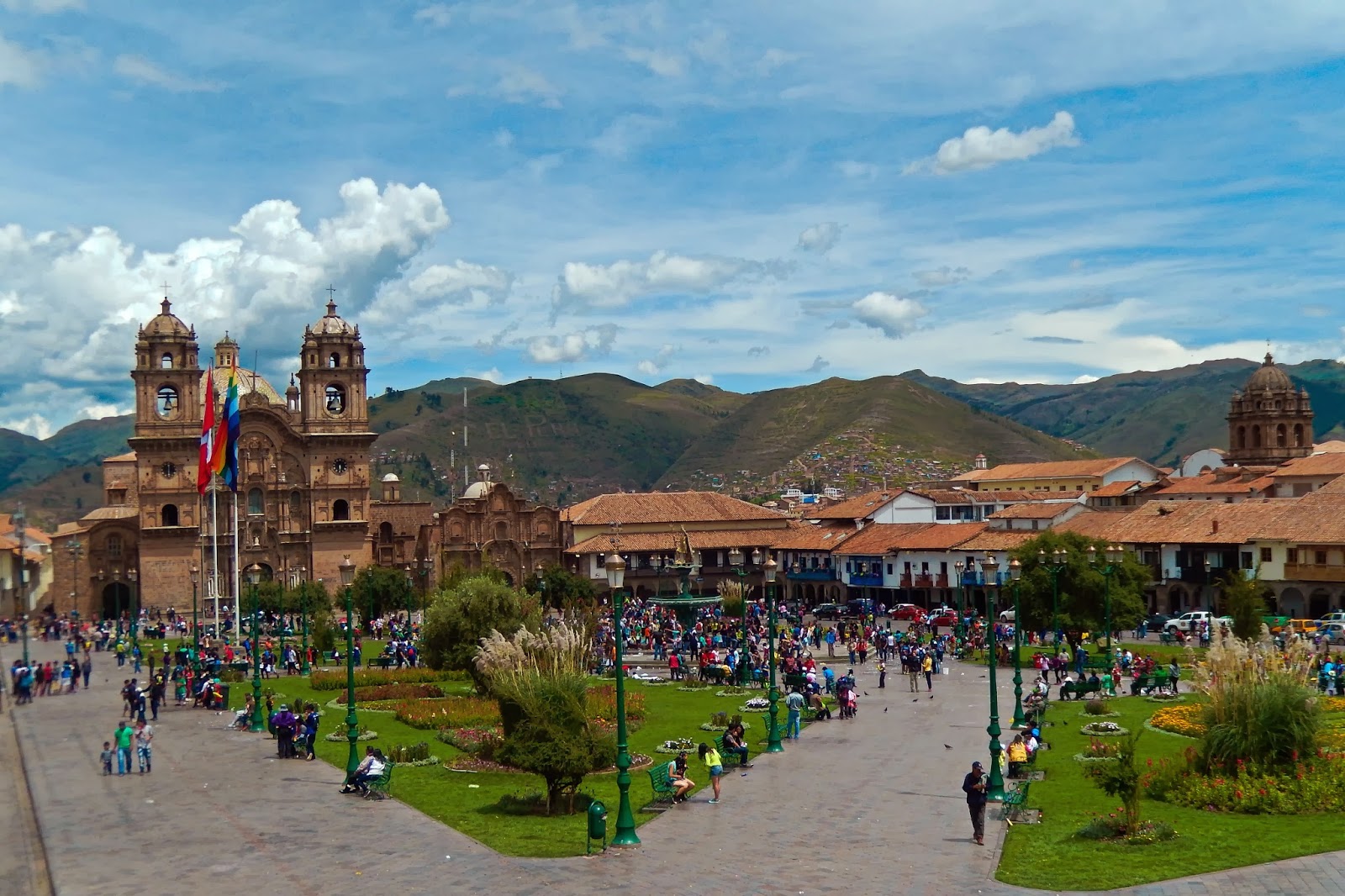
We experienced Cusco both as a group for most of a day, then “left the reservation” on our own for two nights and a day, which is our preferred MO.  With the group we get insights and opportunities that would be hard to prearrange on our own.  But with that comes a bus, schedules and few opportunities for spontaneity and interaction with locals.  Nevertheless, we enjoyed the full-day tour of Cusco, which is a beautiful and fascinating city, a blend of Spanish colonial and Inca culture and architecture. 

Plaza De Armas--the City Center
 The poor live up high, the wealthy live down below
  

Inside a monastery that was built within an Inca temple
The Spanish conquistadors tried to wipe out the Inca structures, but in the end, built their cathedrals and monasteries upon or within them, and the citizens blend Inca beliefs and traditions into their Catholicism.  The Incas built massive temples, terraces, and cities out of stones without the benefit of the wheel or steel tools.   The stones are so well fitted, that it is impossible to insert a razor blade or credit card between them. 
How did they lift and move these boulders and get them to fit?
A street, along the wall of our hotel, which was a huge hacienda in the colonial days, built into Inca stonework


Our second day was the last day of Carnivale, and we set out by foot to walk parts of this city, including some local markets and the dirt streets of lower-class neighborhoods high above the central city.  


When we returned to the Plaza De Armas, we came upon the Carnivale festivities.  We hadn’t had so much fun in a long time.  As dancers and marching bands proceeded around the square, almost everyone was throwing water balloons and shooting spray foam.  


So we bought a large can of foam spray and had a good time retaliating when the locals ambushed us, not knowing we were fully armed. We put up a good fight, but were still no match for the teenagers.   Laughter was everywhere.and we hadn't had so much fun in a long time.

We ended our brief stay in Cusco with a very nice dinner with six others from our group at the Inca Grill.  If we ever have the time, we’ll write about the food, but we’ll need to do that on a full stomach, because just thinking about the delightful fusions of cuisines here makes us hungry. 

On Monday, we spend most of the day getting to Quitos, Ecuador for three days.  We hear it is also a delightful city, but we will miss Peru, its scenery, food, and its friendly people.


Sunday, March 9, 2014

Another Magical Day

Friday, March 7

The sunrise at Machu Picchu is myth promoted by tour companies and the Lonely Planet travel guide, as nearly every morning of the year the place is socked in with clouds and rain.  We got up early and verified, that indeed, a clear sunny morning at Machu Picchu is elusive. 

But it was still worth it.  We climbed countless steps to the Sun Gate at the top of the ridge overlooking the complex, every now and then getting 30-second glimpses of this magical mystical place.


We had one of our best meals ever at lunch in Machu Picchu Town (former Agua Caliente, which is accessible only by a narrow gage railway or by a four day trek over two 12,000 passes.  More about food later, but let’s just say that the food here is diverse and delicious.


We took train for two hours out of the Sacred Valley, then a stunning two-hour bus ride to Cusco through a 12,000 foot plateau through one of the most beautiful places we have ever been.  


Cusco, population 500,000 at an elevation of 11,500 is a fascinating city.  After checking into our hotel which was formerly a huge hacienda from colonial times, we found a fantastic Peruvian restaurant on a long narrow alley for yet another memorable meal.  All and all, a very special and magical day.

Thursday, March 6, 2014

Breathtaking Machu Picchu

In this digital age, there are millions of photos of everything, to the point where they can make the real thing just another common place, ho-hum experience with no element of surprise.  The Inca city called Machu Picchu high in the Andes Mountains of Peru is probably one of the more iconic photos out there.  So as we rode the narrow-gage train through the beautiful tropical Sacred Valley and then took a mini bus up a very steep road to the entry to Machu Picchu, we thought we knew what to expect.   Fortunately, we were wrong—very wrong.  It was a sight and an experience that literally took our breaths away, and not just because of the altitude.


Temple of the Sun


We’ve been to a number of very amazing places together over the past 37 years, but we’ve had only a small number of unforgettable first impressions.  So it is challenging to find something to top or equal such iconic sights like the Thangboche Monastery at the base of Mt. Everest or the Golden Temple and Taj Mahal in India. Machu Picchu succeeded beyond all expectations to the point that it was an emotional experience.


We're staying 2,000 feet lower along a roaring river, a major tributary of the Amazon.  (See Photo below).  We can’t wait until tomorrow to return to the mountain and hike to a high overlook in the early morning.  The weather and the crowds are usually the worst in the morning, but it will be worth it.


View from our hotel window

Tuesday, March 4, 2014

From the Amazon to the Mountains

Yesterday (Monday) we left the Amazon, with a rest stop along the way to see some gigantic piranhas, turtles, caimans and fish.  Hated to leave the jungle, but it was nice to get out of the heat and humidity.  
At a riverside rest stop--The way we used to look
We flew from Iquitos south to Lima, the capitol of Peru.  What surprised us was how bone dry it was for being a coastal city.  In fact, with its population of 10 Million, it is the second largest desert city in the world, after Cairo, Egypt.  The Andes block the prevailing storms, which come from the Atlantic.


Old town Lima was delightful, with colonial architecture going back to the 1500s.  We toured a gigantic   monastery built in the 1600s and saw piles and piles of bones and skulls in its deep catacombs.  Our recollections of The Shining Path, the big earthquake, and President Fujimori were sketchy at best, but our guide gave us a wonderful refresher course and some insights about Peruvian politics and economics. We've only experienced countries that were colonized by the British, Dutch, and French--all in Asia.  The Spaniards were brutal, but at least they had a sense of art and architecture.  
f
Cathedral San Francisco

Lots of architecture like this in central Lima


After a walk through some public plazas we enjoyed an outdoor dinner and observing the vibrant night-time scene where everyone seems to come out and just hang out.  Our 15-story Sheraton was as unremarkable as any other Sheraton in the States, but for the huge contrast from our modest accommodations on the Amazon.


We got up at dawn today, and eventually made it to Cuzco, a large city about 11,000 feet in the Andes. More colonial architecture, but also humble homes tenaciously clinging to the hillside.   Our guide insisted we have lunch at the Peruvian version of McDonalds, and it turned out to be a very pleasant surprise.  They use dehydrated potatoes in the burgers and special cheese.   

We rode for over two hours over a 12,400 foot verdant plateau spotted with farms and surrounded by towering snow-capped mountains in the distance.  We are now staying in a beautiful and isolated lodge in the Sacred Valley, at an elevation of 9,500 feet for nights to better help everyone get used to the altitude when we go much higher to Machu Picchu  In a couple of days.  

Tomorrow we go to an off-the-beaten path to an archaeological site where the Incas still live among the ruins.

From the plateau looking down to the Sacred V

Where we're spending the night--Casa Andina

Monday, March 3, 2014

The Upper Amazon

Sunday, March 2
  
In spite of lengthy delays and the chaotic airport at Lima, we made it.  Captain Kirk’s teleporter aboard the Starship Enterprise may have been faster, but in 24-ish hours and three time zones later, we transported from cold Salem to the subequatorial Amazon basin of central Peru.  Air travel, for all of its hassles, is still pretty amazing.

But not as amazing as the Amazon.  We’re we are with a congenial and interesting group of four from Salem and four from other parts of the USA.  We’re staying at Ceiba Tops, an eco-resort on the Amazon founded by a former Peace Corps volunteer.  He has since created three other lodges that employ many people and help preserve the Amazon culture and environment.  The grounds are beautiful, the insects buzz loudly, and it smells like a fragrant oxygen-rich green house in a botanical garden.  We are about two hours down river from Iquitos, which is only accessible by air or water.  With a population of 900,000 it is the largest city in the world not connect by roads to any other town or city.  Most freight travels in barges 2300 miles up the Amazon from the Atlantic.  Where we are now, the Amazon is four miles wide, including islands.  Imagine what it must be like farther downstream!

We spent 2 ½  very full days exploring the river, the people, and the birds, and animals by open boat.  Small huts, villages, towns, water bus stops, birds, people, you name it.  But it is mostly vast horizons and the jungle right to the shoreline.   So beautiful, so much variety, so many sounds.  Our guide grew up in a village on the Amazon and he has a degree in the history of the rainforest, so we’re learning more than we bargained for. 


Beyond the amazing natural beauty, flora, and fauna, what have we seen or done?  We visited a, village of an indigenous tribe on an island, tried our cheeks at blow gun target practice, saw pink dolphins, rode motorcycle taxis to see another town, swang  from vines  of a giant cieba tree the size of a redwood, socialized a lot over Amazonian Beer and Inka Juice, ate some local delacies (including fried moth larve), and tried our luck at piranha fishing, but both of us got skunked.  The others in our group did better, so we’re having piranha for dinner.   

the giant cieba tree

On Monday we go back upriver to Iquitos to catch a two-hour flight to Lima, which is farther south and on the coast.  Then on to Cusco and the Magic Valley of the Incas.   Although we can’t wait for that, we will miss this amazing jungle environment, the people, and the river culture.  We’re glad we opted to do this as long as we were “in the neighborhood” because it is a once-in-a-lifetime experience.  And to think it wasn’t even on our bucket list!